Management And Procurement Of Spares On Ships: How To Identify, Order & Reduce Costs
An authoritative technical guide on shipboard inventory management, 6-digit IMPA & ISSA catalog standardization, OEM vs. compatible marine spares, and how Chief Engineers eliminate off-hire risks at port.
Universal 6-Digit IMPA & ISSA Coding Eliminates Language And Specification Mismatches Across Global Ports.
Planned Maintenance System (PMS) Integration Prevents Emergency Air-Freight Surcharges And Vessel Off-Hire.
Categorizing Critical Class-Mandatory Spares Vs. Consumable Engine & Deck Stores Optimizes Vessel OPEX.
Why Shipboard Spare Parts & Store Management Is Critical At Sea
A merchant vessel sailing across international waters operates as a self-contained industrial power plant. Unlike shore-based factories that can summon a local vendor within hours, a container ship, bulk carrier, or chemical tanker mid-ocean relies entirely on its onboard spare parts inventory and the accuracy of its next port-of-call ship chandler.
As marine engineer Arjun Somani highlights in Marine Insight, poor inventory tracking or ambiguous requisition descriptions frequently result in wrong flange standards (JIS vs. DIN vs. ANSI), mismatched valve pressure ratings, or incorrect packing grades arriving at the gangway — costing shipowners thousands of dollars in emergency air freight and terminal delays.
The 6-Digit IMPA Marine Stores Guide (MSG) Standard
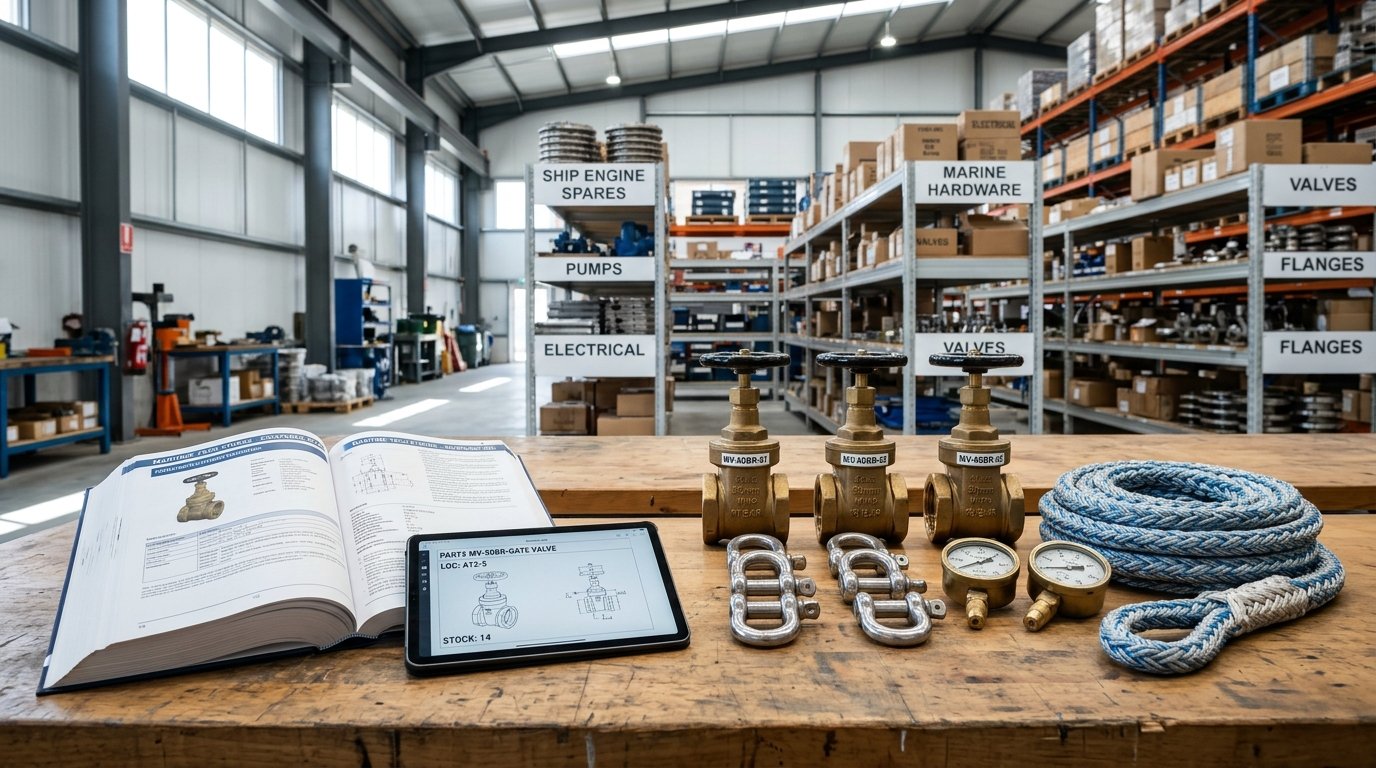
To standardize maritime purchasing globally, the International Marine Purchasing Association (IMPA) established a universal 6-digit coding framework covering more than 50,000 deck, engine, cabin, safety, and galley items. The first two digits identify the primary store category — such as Category 21 (Ropes & Hawsers), Category 23 (Rigging & General Deck Items), Category 33 (SOLAS Safety Equipment), Category 55 (Marine Chemicals), Category 61–67 (Hand & Cutting Tools), and Category 81 (Engine Packing & Jointing) — while the remaining four digits lock in the exact dimension, material grade, and DIN/ISO/JIS standard.
When a Chief Engineer or Purchasing Superintendent submits a requisition containing exact 6-digit IMPA or ISSA codes, an experienced ship chandler can cross-reference warehouse stock immediately, quote within 2 to 4 hours, and guarantee 100% technical accuracy upon delivery at berth or outer anchorage (OPL).
Four Proven Strategies To Reduce Marine Procurement Costs
First, synchronize onboard Planned Maintenance Systems (PMS) with minimum-stock reorder triggers so consumables and overhaul kits are consolidated at major commercial ports rather than ordered as last-minute urgent dispatches.
Second, distinguish between Class-critical OEM machinery components (main engine fuel injection, turbocharger bearings, purifiers) and general technical consumables where IMPA-certified marine-grade equivalents offer identical durability at 25% to 40% lower expenditure.
Third, partner with an ISO 9001:2015-certified local ship chandler at strategic hubs like Karachi Port (KPT), Port Qasim (PQA), and Gwadar Deep Sea Port to combine provisions, bonded stores, deck/engine hardware, and afloat repairs into a single customs-cleared barge or truck delivery.
Need 24/7 IMPA & HACCP Vessel Supply In Pakistan?
Get an itemized quotation within 2–4 hours for Karachi Port (KPT), Port Qasim (PQA), or Gwadar.
More Maritime Industry Articles
IMPA: How Marine Purchasing Executives & Ship Chandlers Lead The Green Transition
MLC 2006 Regulation 3.2: Food Provision Supply, Cold-Chain Hygiene & Ship Chandler Accountability